


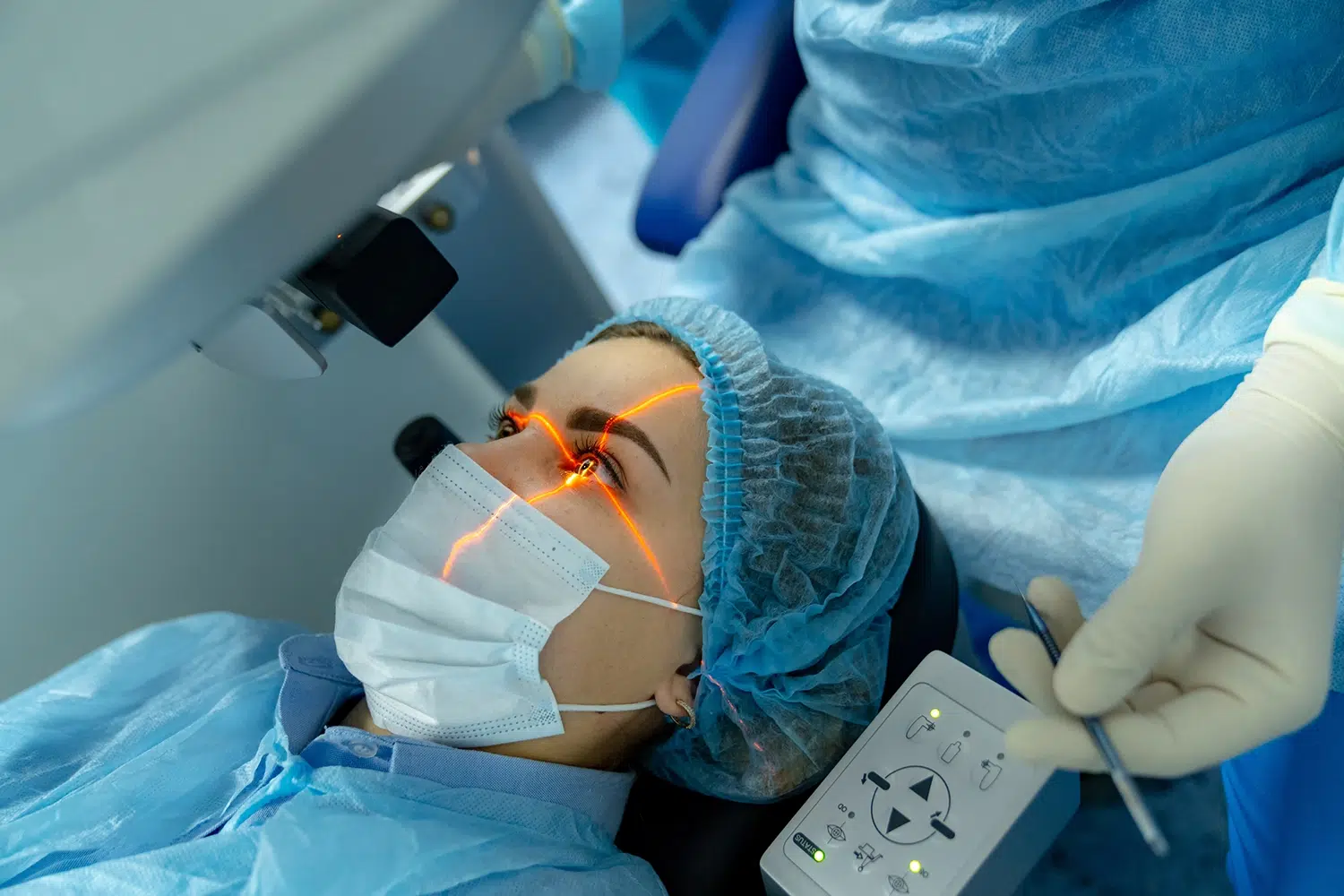
- The LASIK corneal flap persists permanently and can be displaced by a direct blow to the eye. This makes LASIK unsuitable for contact sport, martial arts, and military roles.
- SMILE is flapless and causes less post-operative dry eye than LASIK. It suits patients with borderline dry eye or recreational contact sport participation, but is indicated only for myopia and myopic astigmatism.
- PRK is recommended for thinner corneas and high-impact lifestyles. Recovery is slower, with full stability taking up to three months.
- All three procedures achieve comparable long-term outcomes. The right choice depends on your corneal anatomy, dry eye status, and lifestyle.
You train regularly. It might be boxing, football, martial arts, or any sport that involves physical contact. Glasses are not an option during training, and contacts come with their own frustrations: dryness, displacement, the risk of losing one mid-session.
Laser eye surgery sounds like the obvious solution. But which type is suitable for someone with your active lifestyle?
LASIK is one of the most widely performed refractive procedures in Singapore, but it creates a thin flap in the cornea that remains permanently. SMILE and PRK are both flapless procedures, and for many active patients they are the more appropriate choice.
This article explains the differences between all three procedures so you can have a more informed conversation at your pre-operative assessment.
LASIK, SMILE and PRK: What Does Each Procedure Do?
LASIK (Laser-Assisted In Situ Keratomileusis)

The flap persists permanently. It does not fully reintegrate with the surrounding corneal tissue, and a direct blow to the eye carries a small but real risk of displacement, which is why LASIK is generally not recommended for contact sports or occupations involving regular eye impact risk (Tsai et al., 2017, PMID 28458585; Xiao et al., 2014, PMID 24735774; Kim & Silverman, 2010, PMID 20677731).
Recovery is rapid, with most patients functional within 24 hours and returning to desk work within one to two days.
Dry eye is a further consideration. Creating the flap severs subbasal corneal nerves that contribute to tear production, and in patients with significant pre-existing dry eye, symptoms can worsen noticeably after surgery (Dossari, 2024, PMID 38916023).
SMILE (Small Incision Lenticule Extraction)

Because fewer corneal nerves are transected, research suggests SMILE is associated with less post-operative dry eye and no flap-related complications (Wong et al., 2019, PMID 31490199).
Visual recovery is slightly slower than LASIK in the first week, with full clarity typically by week two. Final outcomes for myopia and myopic astigmatism are comparable to LASIK (Ahluwalia & Manche, 2025, PMID 40279261).
SMILE is indicated only for myopia and myopic astigmatism; it may not be suitable for those with hyperopia or certain astigmatism profiles (Wan et al., 2025, PMID 40588075).
PRK and TransPRK (Surface Ablation)
LASIK corrects myopia, hyperopia, and astigmatism. It does not correct presbyopia, the age-related loss of near vision that typically begins in the 40s. It also does not change the underlying length or shape of the eyeball, which means that high myopes retain their retinal risk after surgery.

Because no tissue is removed for a flap or lenticule, PRK preserves maximum stromal thickness, making it the recommended option for thinner corneas and for patients in high-impact roles (Gurnani & Patel, 2025, PMID 31751077).
Recovery is slower: a bandage contact lens is in place for three to five days, clear vision arrives by week two, and full refractive stability takes up to three months (Gurnani & Patel, 2025, PMID 31751077; Jacobs et al., 2023, PMID 36543604).
Despite the longer recovery, PRK carries no flap-related risks and is typically recommended for patients in high-impact sports, military and police roles, and contact disciplines such as martial arts.
What to Watch For
- Blurry or fluctuating vision in the first one to two weeks after PRK. This is expected and not a sign of a poor outcome.
- Mild discomfort or sensitivity in the first three days after surface ablation. The bandage lens helps but does not eliminate all sensation.
- Any sudden deterioration in vision, increased redness, or discharge after any procedure. Seek assessment promptly.
Which Laser Eye Surgery Suits Your Eyes and Lifestyle?
| Lens type | Best suited to | Glasses after surgery? |
| Monofocal IOL | Clear vision at one fixed distance (near or far) | Likely for some tasks |
| Multifocal IOL | Patients needing to switch between near and distance tasks frequently | Often not required |
| EDOF IOL | Good distance and intermediate vision with minimal glare risk | Rarely for distance; may need for fine near work |
| Toric IOL | Patients with astigmatism requiring correction alongside cataract removal | Reduced dependence |
When LASIK is the right choice
LASIK suits patients with adequate corneal thickness, no significant dry eye, a prescription within the treatable range, and a lifestyle that does not involve regular direct eye impact. It offers the fastest visual recovery of the three procedures.
If your corneal topography is normal and your daily life does not involve contact sport or high-impact risk, a LASIK laser operation is typically the most practical option. If your pre-operative eye screening shows mild or absent dry eye, the temporary nerve disruption from flap creation is unlikely to produce a clinically significant problem.
When SMILE is the right choice
SMILE suits patients who have borderline dry eye, participate in contact sports at a recreational level, or prefer a no-flap approach. Final outcomes for myopia and myopic astigmatism are comparable to LASIK, with a marginally slower first-week recovery.
The flapless technique preserves more of the subbasal corneal nerve plexus, reducing dry eye disruption post-operatively (Ganesh et al., 2018, PMID 29283117).
SMILE is not suitable for patients in full-contact martial arts or military roles where the structural security of PRK is needed.
When PRK is the right choice
- Compete in boxing, mixed martial arts, or full-contact combat sports
- Play contact team sports such as rugby where head and facial impact is frequent
- Work in a role involving regular physical confrontation, such as police or military service
- Have had a previous refractive procedure and your corneal surface is irregular
How Long Does Recovery Take for Each Procedure?
Realistic timelines side by side
| LASIK | SMILE | PRK | |
| Vision at 24 hours | Significant improvement; most patients functional | Meaningful improvement; slightly slower than LASIK | Blurry; bandage lens in place |
| Return to desk work | 1–2 days | 2–3 days | 5–7 days typically |
| Clear vision | 1–2 days | 1–2 weeks | 2 weeks |
| Full stability | 1–3 months | 1–3 months | Up to 3 months |
| Flap risk | Present permanently | None | None |
| Dry eye risk | Higher | Lower | Low |
What to Watch For
- Halos, glare, or starbursts around lights in the first weeks after any procedure. These typically resolve as the cornea stabilises.
- Persistent dry eye symptoms beyond the first three months. More common after LASIK than SMILE or PRK, and manageable with treatment.
- Any change in vision quality that does not follow the expected recovery trajectory. Raise this at your post-operative follow-up.
Book Your Laser Eye Surgery Assessment at Angel Eye & Cataract Centre
A pre-operative assessment is the only way to determine which procedure is appropriate for your eyes. Without one, no surgeon can give you a confident recommendation.
Dr Allan Fong is a Senior Consultant Eye Surgeon and Medical Director at Angel Eye & Cataract Centre, with over 26 years of experience in ophthalmology.
The right laser eye surgery for you depends on your prescription, corneal anatomy, and lifestyle. Book a pre-operative assessment at Angel Eye & Cataract Centre and Dr Allan Fong will walk you through the options that are right for your eyes.
References
Tsai TH, Peng KL, Lin CJ. Traumatic corneal flap displacement after laser in situ keratomileusis (LASIK). International Medical Case Reports Journal. 2017;10:143–148. PMID: 28458585; PMC5403011
Xiao J, Jiang C, Zhang M, et al. When case report became case series: 45 cases of late traumatic flap complications after laser-assisted in situ keratomileusis and review of Chinese literature. British Journal of Ophthalmology. 2014;98(9):1282–1286. PMID: 24735774
Kim HJ, Silverman CM. Traumatic dislocation of LASIK flaps 4 and 9 years after surgery. Journal of Refractive Surgery. 2010;26(6):447–452. PMID: 20677731
Dossari SK. Post-refractive surgery dry eye: a systematic review exploring pathophysiology, risk factors, and novel management strategies. Cureus. 2024;16(5):e61004. PMID: 38916023; PMC11194137
Wong AHY, Cheung RKY, Kua WN, Shih KC, Chan TCY, Wan KH. Dry eyes after SMILE. Asia-Pacific Journal of Ophthalmology. 2019;8(5):397–405. PMID: 31490199; PMC6784859
Ganesh S, Brar S, Arra RR. Refractive lenticule extraction small incision lenticule extraction: a new refractive surgery paradigm. Indian Journal of Ophthalmology. 2018;66(1):10–19. PMID: 29283117; PMC5778540
Ahluwalia A, Manche EE. Comparing femtosecond LASIK and small-incision lenticule extraction (SMILE). Current Opinion in Ophthalmology. 2025;36(4):276–281. PMID: 40279261
Wan KH, Wang XY, Lai KHW, et al. Controversies, consensuses and guidelines on small incision lenticule extraction (SMILE) by the AAPPO and APMS. Asia-Pacific Journal of Ophthalmology. 2025;14(4):100221. PMID: 40588075
Gurnani B, Patel BC. Photorefractive keratectomy. In: StatPearls. StatPearls Publishing; 2025. PMID: 31751077
Jacobs DS, Lee JK, Shen TT, et al. Refractive Surgery Preferred Practice Pattern. Ophthalmology. 2023;130(3):P61–P135. PMID: 36543604
