


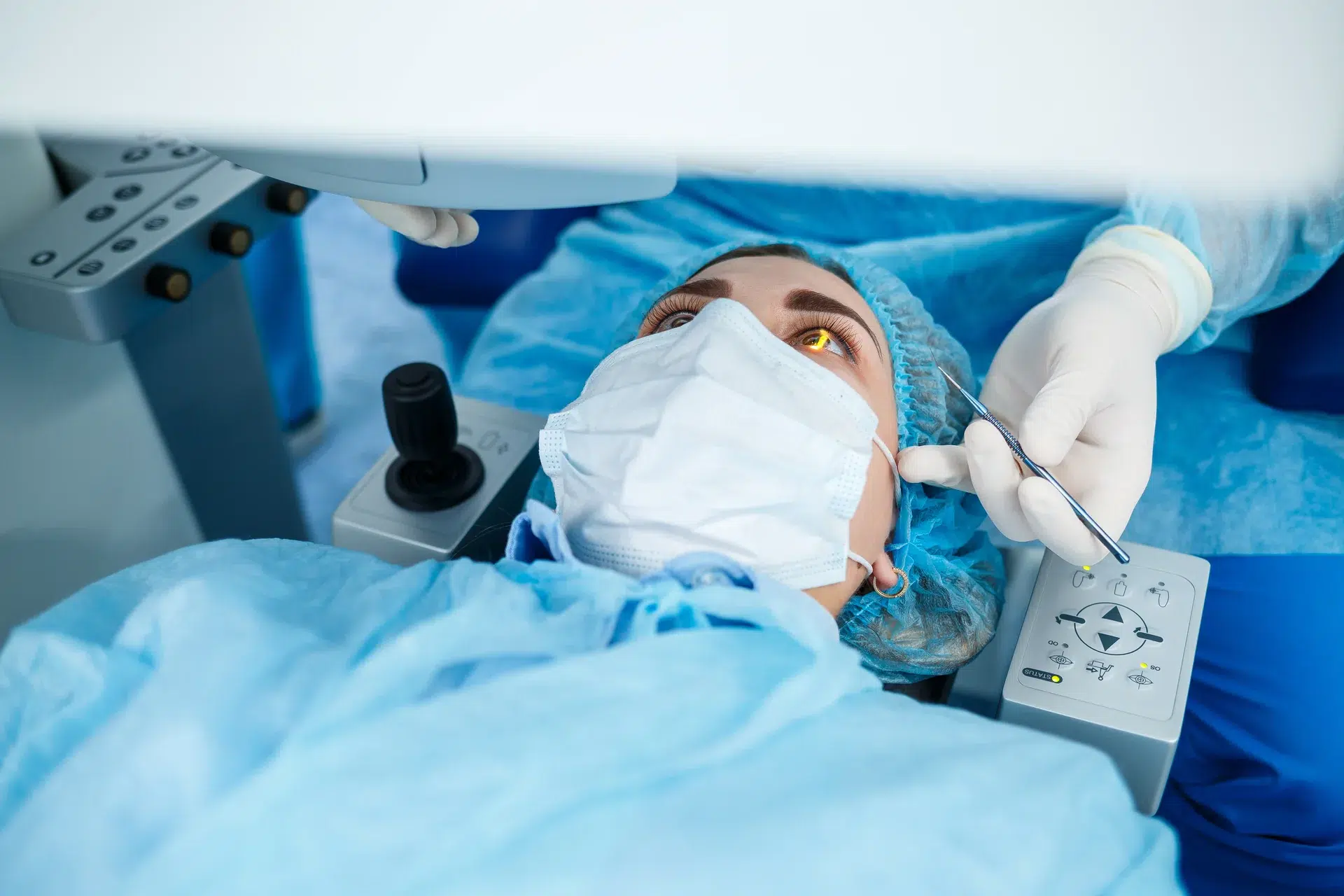
- LASIK corrects myopia, hyperopia, and astigmatism by reshaping the cornea. It does not correct presbyopia and does not reduce retinal risk in high myopes. Annual retinal checks remain necessary after surgery.
- Candidacy depends on age, prescription stability, corneal thickness and shape, dry eye status, and prescription range. A pre-operative assessment is required before any recommendation can be made.
- SMILE is a flapless alternative to LASIK that may cause less post-operative dry eye and suits patients in contact sports. It is currently indicated only for myopia and myopic astigmatism.
- The pre-operative assessment is the most important appointment in the process. It covers corneal topography, pupil size, tear film evaluation, and a full refraction check.
You notice it out of the corner of your eye: a fleeting flash of light, or a small dark speck drifting across your vision that was not there yesterday. It lasts a second. You blink, look again, and it seems to have settled. You tell yourself you are tired or have had too much screen time.
In that particular moment, deciding whether something is worth acting on, is where people tend to choose the wrong tier of eye care, or no care at all.
In Singapore, there are general practitioners, optometrists, and eye specialists. Knowing which to consult, and when, is what this guide covers.
Is LASIK Right for You? What to Check Before Booking
Your glasses fog the moment you step outside. They slide when you exercise, smudge in humidity, and break or get lost easily. After years of managing the same small frustrations, the question of whether to do something permanent about your vision has started to feel less like an indulgence and more like a sensible decision.

LASIK is one of the most widely performed refractive surgeries in the world, but “widely performed” is not the same as “right for everyone.” Candidacy depends on the shape and thickness of your cornea, your prescription, your tear film, and several other factors that can only be assessed properly in a clinical setting.
Before you book anything, here is what you need to understand about the procedure, what makes someone a suitable candidate, and how LASIK in Singapore compares to newer alternatives.
How Does LASIK Work?
The procedure in plain language
LASIK eye surgery uses two lasers in sequence to correct your vision. A femtosecond laser creates a thin flap in the cornea, an excimer laser reshapes the underlying tissue to correct your refractive error, and the flap is repositioned. The entire procedure takes 10 to 15 minutes per eye under topical anaesthetic drops.

A femtosecond laser creates a thin, precise flap in the outer layer of the cornea (Sioufi et al., 2021, PMID 33516763).
The surgeon lifts the flap to expose the stromal tissue beneath, and an excimer laser then reshapes that tissue according to measurements taken during your pre-operative assessment (MedlinePlus, US National Library of Medicine).
The reshaping corrects the refractive error.
- In myopia (short-sightedness), the laser flattens the cornea to redirect light onto the retina correctly.
- In hyperopia (long-sightedness), it steepens the central cornea.
- In astigmatism (an irregularly shaped cornea), it smooths the uneven curvature.
Once complete, the flap is repositioned, seals itself within hours, and most patients notice improved vision within a day (Ahluwalia & Manche, 2025, PMID 40279261).
What LASIK can and cannot fix
LASIK corrects myopia, hyperopia, and astigmatism. It does not correct presbyopia, the age-related loss of near vision that typically begins in the 40s. It also does not change the underlying length or shape of the eyeball, which means that high myopes retain their retinal risk after surgery.
LASIK is a corneal procedure. It changes how light bends as it enters the eye, but does not alter the axial length of the eyeball. For patients with high myopia, the retina remains as stretched as it was before surgery.
Annual retinal checks remain just as important after LASIK, and arguably more so, because the glasses that previously prompted a clinic visit are no longer part of the routine.
Presbyopia is a separate issue caused by changes to the lens inside the eye, not the corneal shape. Standard LASIK does not address it, as LASIK is indicated only for the correction of myopia, hyperopia, and astigmatism at the corneal surface (Jacobs et al., 2023, PMID 36543604).
Patients over 40 should discuss monovision LASIK or lens-based options with their surgeon before proceeding.
What to Watch For
- New or worsening floaters, flashes of light, or a shadow in your visual field after LASIK. Seek same-day assessment.
- Difficulty reading small print that worsens progressively from your mid-40s onwards. This may indicate presbyopia developing independently of your LASIK outcome.
- Any change in vision quality that your post-operative prescription does not explain.
If you have high myopia, presbyopia, or other considerations, the right starting point is a conversation with a specialist. Book a pre-operative assessment at Angel Eye & Cataract Centre to find out where you stand.
Who Is a Good Candidate for LASIK?
The criteria that matter
Candidacy for LASIK depends on age, prescription stability, corneal thickness and shape, dry eye status, and prescription range. A thorough pre-operative assessment is required before any recommendation can be made.

LASIK candidacy: key criteria
- Age and prescription stability: typically 21 and above, with a stable prescription for at least 12 months (Mimouni et al., 2018, PMID 29075941).
- Corneal thickness: if the cornea is too thin, there may not be sufficient material to achieve the correction safely. Thinner corneas may be better suited to Advanced Surface Ablation (ASA).
- Corneal shape: conditions such as keratoconus (a progressive thinning and bulging of the cornea) are a contraindication, even in early forms.
- Dry eye status: LASIK temporarily disrupts the corneal nerves responsible for tear production. Pre-existing dry eye may worsen post-operatively (Dossari, 2024, PMID 38916023).
- Prescription range: very high prescriptions may exceed what LASIK can safely achieve. These patients may be better suited to implantable collamer lens (ICL) surgery.
What to Watch For
- Persistent dryness, grittiness, or a burning sensation in your eyes. These may indicate pre-existing dry eye that should be assessed before proceeding.
- Eyes that feel worse in air-conditioned environments, on long flights, or after screen use. Worth flagging at your pre-operative appointment.
- A prescription that has changed at your last one or two eye tests. Bring your prescription history to the assessment.
The pre-LASIK assessment
The pre-operative assessment covers corneal topography, pupil size, tear film evaluation, and a full refraction check under cycloplegic drops. This takes approximately one to two hours and is the most important appointment in the entire process.
- Corneal topography: maps the shape and thickness of both corneas, identifying irregularities or early signs of keratoconus that could affect surgical planning.
- Pupil size assessment: large pupils in low-light conditions can contribute to post-operative glare or halos.
- Tear film evaluation: includes a Schirmer’s test to measure tear production and an ocular surface assessment.
- Cycloplegic refraction: drops temporarily relax the focusing muscles of the eye, ensuring the laser is programmed with the most accurate prescription data.
LASIK or SMILE: Which Procedure Is Right for You?
The key differences
SMILE (small incision lenticule extraction) is a flapless alternative to LASIK. It removes a small disc of corneal tissue through a keyhole incision rather than creating a flap. It may offer advantages in dry eye and stability for contact sport participants, but is not suitable for all prescriptions.

- Corneal topography: maps the shape and thickness of both corneas, identifying irregularities or early signs of keratoconus that could affect surgical planning.
- Pupil size assessment: large pupils in low-light conditions can contribute to post-operative glare or halos.
- Tear film evaluation: includes a Schirmer’s test to measure tear production and an ocular surface assessment.
- Cycloplegic refraction: drops temporarily relax the focusing muscles of the eye, ensuring the laser is programmed with the most accurate prescription data.
| Feature | LASIK | SMILE |
|---|---|---|
| Flap | Femtosecond laser creates a corneal flap | Flapless; lenticule removed through a small incision |
| Corneal nerve disruption | Greater; flap severs more nerve fibres | Reduced; flapless approach preserves more nerve density |
| Post-operative dry eye risk | Higher, particularly in pre-existing dry eye patients | Lower, based on current evidence |
| Contact sport suitability | Flap dislodgement risk, however rare | No flap; generally considered more stable |
| Indications | Myopia, hyperopia, astigmatism | Primarily myopia and myopic astigmatism |
| Visual recovery speed | Quicker | Slightly slower initially |
Because the flapless approach preserves more of the corneal nerve network, research suggests SMILE may result in less disruption to tear production post-operatively (Wong et al., 2019, PMID 31490199).
It is also better suited to patients in contact sports where a flap dislodgement, however rare, carries risk (Ahluwalia & Manche, 2025, PMID 40279261).
SMILE is currently indicated primarily for myopia and myopic astigmatism, and not all prescription ranges are treatable (Wan et al., 2025, PMID 40588075; Ganesh et al., 2018, PMID 29283117).
What to Watch For
- Halos, glare, or starbursts around lights in the first weeks after surgery. Common post-operatively and typically resolve, but should be monitored.
- Persistent dry eye symptoms beyond the first few months. More likely after LASIK than SMILE, and manageable with treatment if caught early.
- Fluctuating vision during the healing period. Sustained fluctuation beyond three months warrants a follow-up.
Not sure whether LASIK or SMILE is right for you? Arrange an assessment with Dr Allan Fong and get a recommendation based on your eyes, not a general rule.
What Does LASIK Cost in Singapore, and What Is Included?
What the price covers
LASIK at a private clinic in Singapore typically includes the pre-operative assessment, the procedure itself, post-operative drops, and follow-up visits. SMILE is generally priced higher than standard LASIK. Medisave eligibility for LASIK is restricted and depends on clinical criteria.
The quoted price for LASIK in Singapore should cover the full package: pre-operative work-up, the procedure, post-operative medication, and follow-up appointments.
SMILE typically commands a higher price than standard LASIK, reflecting differences in equipment and technique.
For most patients, LASIK and SMILE are not covered by Medisave, as the MOH classifies elective refractive surgery as cosmetic. An exception applies where there is a difference of more than three dioptres between the two eyes and the patient is intolerant to glasses and contact lenses (MOH, Medisave not for cosmetic LASIK).
Further details on financing options are available on the Angel Eye & Cataract Centre website.
Book Your LASIK Assessment at Angel Eye & Cataract Centre
Without a thorough pre-operative assessment, no surgeon can tell you whether you are a suitable candidate, which procedure is right for you, or what outcome you can realistically expect.
Dr Allan Fong is a Senior Consultant Eye Surgeon and Medical Director at Angel Eye & Cataract Centre, with over 26 years of experience in ophthalmology. He performs LASIK and SMILE at SNEC Laservision using the Zeiss Visumax 800.
Book your LASIK assessment at Angel Eye & Cataract Centre today.
References
- Sioufi K, Zheleznyak L, MacRae S, Rocha KM. Femtosecond lasers in cornea and refractive surgery. Experimental Eye Research. 2021;205:108477. PMID: 33516763
- Ahluwalia A, Manche EE. Comparing femtosecond LASIK and small-incision lenticule extraction (SMILE). Current Opinion in Ophthalmology. 2025;36(4):276–281. PMID: 40279261
- Jacobs DS, Lee JK, Shen TT, et al. Refractive Surgery Preferred Practice Pattern. Ophthalmology. 2023;130(3):P61–P135. PMID: 36543604
- Mimouni M, Flores V, Shapira Y, et al. Correlation between central corneal thickness and myopia. International Ophthalmology. 2018;38(6):2547–2551. PMID: 29075941
- Dossari SK. Post-refractive surgery dry eye: a systematic review exploring pathophysiology, risk factors, and novel management strategies. Cureus. 2024;16(5):e61004. PMID: 38916023; PMC11194137
- Ganesh S, Brar S, Arra RR. Refractive lenticule extraction small incision lenticule extraction: a new refractive surgery paradigm. Indian Journal of Ophthalmology. 2018;66(1):10–19. PMID: 29283117; PMC5778540
- Wong AHY, Cheung RKY, Kua WN, Shih KC, Chan TCY, Wan KH. Dry eyes after SMILE. Asia-Pacific Journal of Ophthalmology. 2019;8(5):397–405. PMID: 31490199; PMC6784859
- Wan KH, Wang XY, Lai KHW, et al. Controversies, consensuses and guidelines on small incision lenticule extraction (SMILE) by the Academy of Asia-Pacific Professors of Ophthalmology (AAPPO) and the Asia-Pacific Myopia Society (APMS). Asia-Pacific Journal of Ophthalmology. 2025;14(4):100221. PMID: 40588075
- MedlinePlus. LASIK eye surgery. US National Library of Medicine. Available at: https://medlineplus.gov/ency/article/007018.htm
- Ministry of Health Singapore. Medisave not for cosmetic LASIK. 8 March 2006. Available at: https://www.moh.gov.sg/newsroom/medisave-not-for-cosmetic-lasik/
