


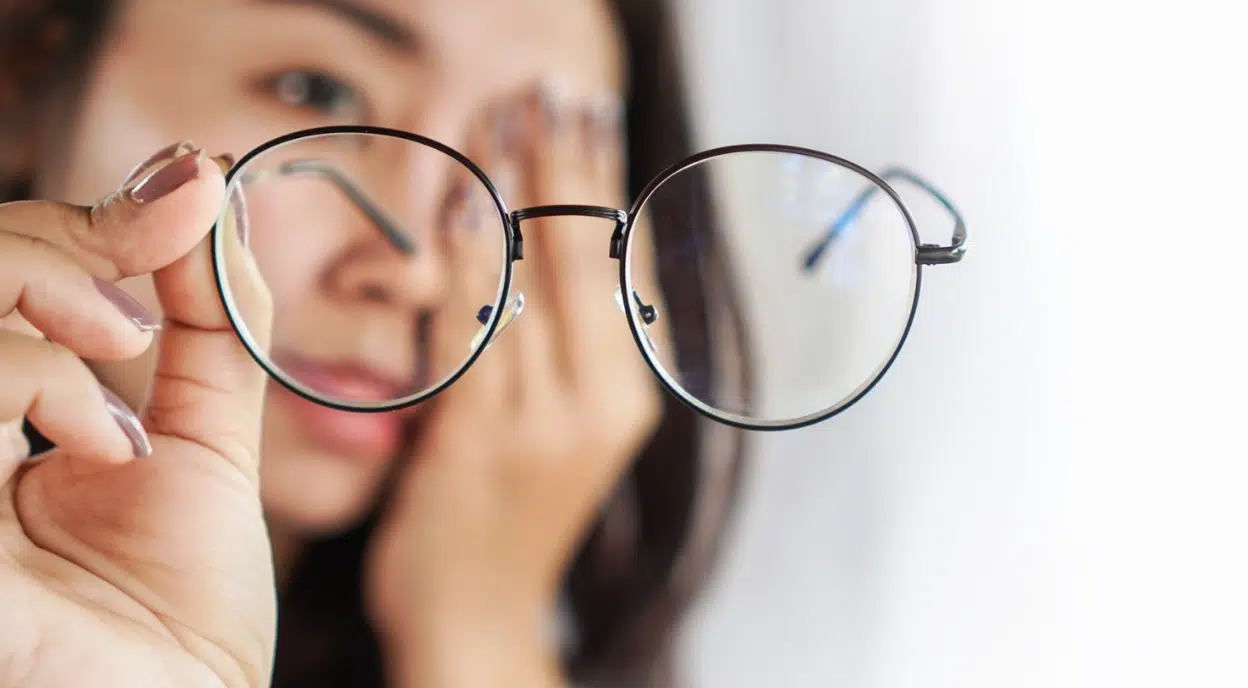
You step outside into the thick, humid air and walk five minutes to the MRT. Then the doors open and you are hit by a wall of cold, dry air-conditioning. You repeat this three or four times before you even reach your desk. By mid-morning, your eyes already feel uncomfortable and heavy.
Sound familiar? Many of us accept this as part of daily life in Singapore, something to put up with rather than something to address. But if your eyes feel sore, tired, or heavy every single day, there is a good chance your body is trying to tell you something.
What you may be experiencing is dry eye syndrome, a condition that affects roughly 12% of Singaporeans. And the way we live here, moving between tropical heat and air-conditioned interiors, staring at screens all day, wearing contact lenses from morning to night, creates near-perfect conditions for it to develop.
The good news is that once you understand what is driving it, you can do something about it.

Hot Outside, Freezing Inside: The Eye Problem Nobody Talks About
Singapore sits on the equator. Outdoor humidity regularly exceeds 80%, and temperatures hover around 31 to 33 degrees Celsius for most of the year. Your tear film, the thin protective layer that keeps your eyes comfortable and clear, is actually quite well suited to warm, humid air.
The problem begins the moment you walk indoors.
Air-conditioning systems work by removing moisture from the air. Office buildings, shopping malls, MRT stations, and buses all maintain indoor environments that are significantly drier than the air outside. Research has confirmed that low indoor humidity is directly linked to worse dry eye symptoms, with office workers in low-humidity conditions reporting higher scores for eye dryness, irritation, and discomfort compared to those in better-humidity environments.
A separate study found that people who spent most of their time indoors had significantly worse tear production than those who spent time outdoors. Indoor participants reported nearly double the dry eye symptom severity of outdoor participants.
So the daily Singapore experience of stepping from humid outdoor air into aggressively air-conditioned spaces, repeatedly, throughout the day, is not neutral for your eyes. Each transition asks your tear film to adapt rapidly, and over time, that repeated stress adds up.
Where it tends to be worst:
- Long commutes on heavily air-conditioned MRT trains
- Open-plan offices with ceiling vents positioned overhead
- Sitting near air-con units in meeting rooms or co-working spaces
- Extended time in shopping malls, clinics, or airport terminals

The Blinking Problem You Did Not Know You Had
Here is something most people do not know: you blink far less than you think you do.
A healthy blink rate is around 15 times per minute. Each blink spreads a fresh layer of tears across your cornea, keeping it moist and protected. But research published in Clinical Ophthalmology found that blink rate can drop to as low as 5 times per minute during focused screen work. The more demanding the task, the more your blinking slows down.
When your blink rate drops that significantly, your tear film breaks down faster than it can be replenished. The surface of your eye becomes exposed, tears evaporate, and discomfort sets in. The research is consistent on this: office workers who use screens for more than 8 hours a day have nearly twice the risk of dry eye disease compared to those with minimal screen use.
What makes Singapore particularly challenging is that screen time does not stop at the office. Many people continue on their phones during the commute, check messages through dinner, and wind down with streaming services in the evening. The eyes rarely get a proper break.
Signs that screens may be contributing:
- Eyes feel fine in the morning but increasingly uncomfortable as the day goes on
- Vision becomes slightly blurred, then clears when you blink
- Discomfort eases when you close your eyes for a few minutes
- Headaches or a heavy feeling around the eyes after long work sessions
Contact Lenses and Dry Eyes: A Cycle Worth Breaking
If you wear contact lenses, your eyes are under additional strain. Studies show that contact lens wearers have over three and a half times the risk of experiencing severe dry eye symptoms compared to non-wearers.
Lenses sit directly on the tear film, absorbing moisture and creating an extra surface from which tears can evaporate. This disrupts the natural stability of the tear film and reduces the eye’s ability to stay lubricated throughout the day. The longer the lenses are worn, particularly in an air-conditioned environment with reduced blinking from screen use, the more noticeable the effect becomes.
Many contact lens wearers notice that their eyes feel comfortable in the morning but become increasingly sore and irritated by the afternoon. If you find yourself reaching for rewetting drops multiple times a day, or switching to glasses earlier and earlier in the evening, your eyes are likely telling you something worth paying attention to.
Signs your lenses may be making things worse:
- Discomfort that worsens as the day goes on, particularly by late afternoon
- Redness or irritation even with a fresh pair of lenses
- Needing rewetting drops more than once or twice a day
- Finding it harder to wear lenses for a full day than you used to

When Eye Drops Are Not Enough
Most people in Singapore manage dry eye the same way: a bottle of lubricating drops from the pharmacy, kept on the desk and used when the discomfort becomes too much. For mild, occasional dryness, this can provide relief.
But if you are using drops several times a day and still feeling uncomfortable, the drops are no longer solving the problem. They are delaying a proper assessment.
Dry eye syndrome exists on a spectrum. Mild cases often respond to lubricating drops and some adjustments to daily habits. But moderate to severe dry eye can involve persistent low-grade inflammation of the eye surface, a problem with the oil glands along the eyelid margins that affect tear quality, or reduced tear production. These cannot be effectively addressed with over-the-counter drops alone.
A comprehensive eye examination is the only way to understand what type of dry eye you have and which treatment will actually work for your specific situation. Continuing to self-manage with drops when the underlying cause is something more can allow the condition to progress quietly over time.
Consider seeing a specialist if:
- You use eye drops every day and still feel uncomfortable
- You have reduced or stopped wearing contact lenses because of dryness
- Your vision fluctuates throughout the day, especially on screens
- Your eyes water frequently, which can paradoxically be a sign of dry eye
- Eye discomfort is affecting your focus or work performance

Small Changes That Can Make a Real Difference
While a proper assessment is important if symptoms are persistent, there are practical steps that can help reduce discomfort as part of daily life.
The 20-20-20 rule is widely recommended and genuinely useful. Every 20 minutes of screen use, look at something 20 feet away for 20 seconds. This allows your eyes to rest and encourages a natural, complete blink. It costs nothing and takes seconds.
Screen position matters too. If your monitor is above eye level, you open your eyes wider to look up at it, which increases tear evaporation. Positioning your screen slightly below eye level and at arm’s length reduces this. Reducing screen brightness so it matches the ambient light in the room also helps.
If you work in an air-conditioned space, a small desktop humidifier can help offset the drying effect of recirculated air. Staying well hydrated throughout the day supports tear production, and if you wear contact lenses, wearing glasses on your heaviest screen days gives your eyes a chance to recover.
These habits help. But they work best alongside, not instead of, professional care if your symptoms are more than occasional.

Dry Eye Care at Angel Eye and Cataract Centre
At Angel Eye and Cataract Centre, we understand that dry eye is not a single condition with a single solution. What works for one person may do very little for another, which is why we start every consultation with a thorough assessment of your tear production, tear film quality, and the health of your eye surface.
Dr Allan Fong has extensive experience diagnosing and managing dry eye syndrome, including cases linked to screen use, contact lens wear, and the environmental demands of life in Singapore. Depending on what the examination reveals, treatment may include preservative-free lubricating eye drops tailored to your type of dry eye, prescription medications to address inflammation or increase tear production, punctal plugs to help retain your natural tears, or oral omega-3 supplementation to support tear film quality.
Every treatment plan is personalised to your lifestyle and your findings. We also provide ongoing monitoring, because for many people dry eye is a long-term condition that benefits from regular review and adjustments over time.
If you have been pushing through tired, sore eyes and telling yourself it is just part of the daily routine, it does not have to be.
Take the Next Step
The uncomfortable eyes on the MRT. The soreness after a long day at your desk. The contact lenses you can barely keep in past three in the afternoon. These are signals, not just inconveniences.
Contact Angel Eye and Cataract Centre today to schedule a comprehensive dry eye assessment. Because comfortable, clear vision matters every single day, not just on good days.Epiretinal membrane is different for everyone. At Angel Eye and Cataract Centre in Singapore, our eye specialist, Dr Allan Fong, will assess your retina carefully to monitor any changes and help determine whether treatment or regular observation is needed.
MEDICAL REFERENCES
- Al-Mohtaseb Z, Schachter S, Shen Lee B, Garlich J, Trattler W. (2021). The Relationship Between Dry Eye Disease and Digital Screen Use. Clinical Ophthalmology, 15:3811-3820. PMC8439964.
- Tsubota K, Nakamura S. (1993). Dry Eyes and Video Display Terminals. New England Journal of Medicine, 328(8):584. PMID: 8426634.
- Chaudhary S, Gupta KK. (2025). Impact of Air Conditioning on Dry Eye Symptoms: A Cross-Sectional Study Using the Ocular Surface Disease Index. Journal of Neonatal Surgery, 14(29S):939-946.
- Mandell JT, Idarraga M, Kumar N, Galor A. (2020). Impact of Air Pollution and Weather on Dry Eye. Journal of Clinical Medicine, 9(11):3740. PMC7699870.
- Galor A, Kumar N, Feuer W, et al. (2020). Association of the Indoor Environment With Dry Eye Metrics. JAMA Ophthalmology, 138(9):971-978. PMC7333174.
- Nichols JJ, et al. (2008). Treatment, Material, Care, and Patient-Factors in Contact Lens-Related Dry Eye. Optometry and Vision Science, 85(8):764-772. PMC2628947.
- Kawashima M, et al. (2017). Contact Lens-Associated Dry Eye Disease: Recent Advances Worldwide and in Japan. Investigative Ophthalmology and Visual Science, 58(11). DOI: 10.1167/iovs.17-21900.
- Tan LL, Morgan P, Cai ZQ, Straughan RA. (2015). Prevalence of and Risk Factors for Symptomatic Dry Eye Disease in Singapore. Clinical and Experimental Ophthalmology, 43(6):544-553. PMID: 25269444.
- Craig JP, et al. (2023). Assessment and Management of Dry Eye Disease and Meibomian Gland Dysfunction: Providing a Singapore Framework. Asia-Pacific Journal of Ophthalmology. ScienceDirect.
