


Summary
- More than one in three older Singaporeans has an undiagnosed eye disease, often without realising it
- One in five seniors has triple sensory loss affecting vision, hearing, and smell together
- Community eye screening in Singapore catches conditions like glaucoma and cataracts early, before vision is impaired
- Screening is most useful when it connects to a follow-up examination at an eye clinic
More than one in three older Singaporeans is walking around with an eye disease they do not know they have.
That is not a projection or a foreign benchmark. It is the finding of the Singapore Eye Research Institute, reported in The Straits Times in 2024, drawn from a population study of seniors in the country we live in. The same study found that one in five has triple sensory loss, the combined impairment of vision, hearing and smell that quietly erodes independence.
The reason these conditions stay hidden is not that they are rare. It is that they are slow. Vision changes that take years to develop tend to be filed away as part of ageing, particularly by a generation that grew up not making a fuss about health unless something hurt. The result is that by the time someone arrives at a clinic, the condition is often well past the easy-to-manage stage.
Community-based eye screening in Singapore exists to close exactly this gap. The question worth asking is whether the current scale is enough.
Why “Silent” Eye Diseases Slip Through
Several of the most common eye conditions affecting older adults are described accurately as silent.
Glaucoma damages the optic nerve from the periphery inward. By the time central vision is affected, irreversible damage has usually already occurred. Patients often have no pain and no obvious symptoms until the visual field has narrowed considerably.
Age-related macular degeneration (AMD) affects central vision but progresses gradually in its dry form. Patients tend to adjust the way they look at things, tilting their head or using peripheral vision, without realising they are compensating for something.
Cataracts develop over the years. Because both eyes are usually affected at similar rates, there is no good eye to compare against, and the brain accepts the new baseline as normal. Glare from headlights, fading colours, and increased tiredness when reading are often filed away as ageing rather than as a treatable condition.
Diabetic retinopathy, in patients with diabetes, can damage the retina substantially before vision is affected. Routine screening is the only reliable way to catch it before bleeding or swelling sets in.
The common thread is that waiting for symptoms is a poor strategy. Screening works because it does not wait.
Where Community Eye Screening Already Reaches
Singapore has a meaningful head start. Programmes like the Health Promotion Board’s See, Hear & Eat Better initiative offer basic vision, hearing and oral health checks for seniors aged 60 and above, conducted at void decks, community centres, and residents’ corners across the island.
The design is deliberate. Bringing the screening to the neighbourhood removes three barriers that keep seniors away from clinics:
- Mobility: A void deck is a lift ride away. A polyclinic involves a bus or taxi, navigating an unfamiliar building, and waiting in a queue.
- Cost concern: Even subsidised consultations carry a perceived cost. A free community screening removes the question.
- Hesitation: Walking into a clinic feels like admitting something is wrong. Sitting down for a free check at a familiar void deck does not.
For seniors who have not seen a doctor in years, sometimes decades, the community setting can be the first point of contact that reveals a problem worth following up.
Where the Gaps Are
Three gaps in the current system are worth naming.
Coverage is uneven. Community screenings exist, but they do not yet reach every senior in every estate at the cadence the SERI data implies is needed. A senior who misses a screening day, or whose block is not in the rotation, can go years without an eye check.
Awareness is patchy. Seniors who would benefit most are often the least connected to the channels that announce screenings. Family members, grassroots volunteers, and community befrienders carry most of the load in getting the word out.
Follow-up is the weakest link. A screening that flags a possible eye problem is only useful if the person actually attends a follow-up appointment. Studies of community screening programmes in Singapore and elsewhere have repeatedly found that a meaningful proportion of flagged participants never complete the referral, whether because of cost, confusion about where to go, or the same hesitation that kept them away from clinics in the first place.
Expanding community eye screening in Singapore is not just about running more screening events. It is about making sure each one connects cleanly to the next step.
What an Eye Screening Actually Checks
For readers who have never attended one, a community eye screening typically takes around 15 to 30 minutes and includes:
- Visual acuity testing with a standard chart, to measure clarity of vision at a distance
- Basic external eye examination to look for visible abnormalities of the lens, conjunctiva, or eyelid
- Intraocular pressure measurement in some programmes is used as a screening signal for glaucoma risk
- A short questionnaire about symptoms, family history, and existing conditions like diabetes that affect eye health
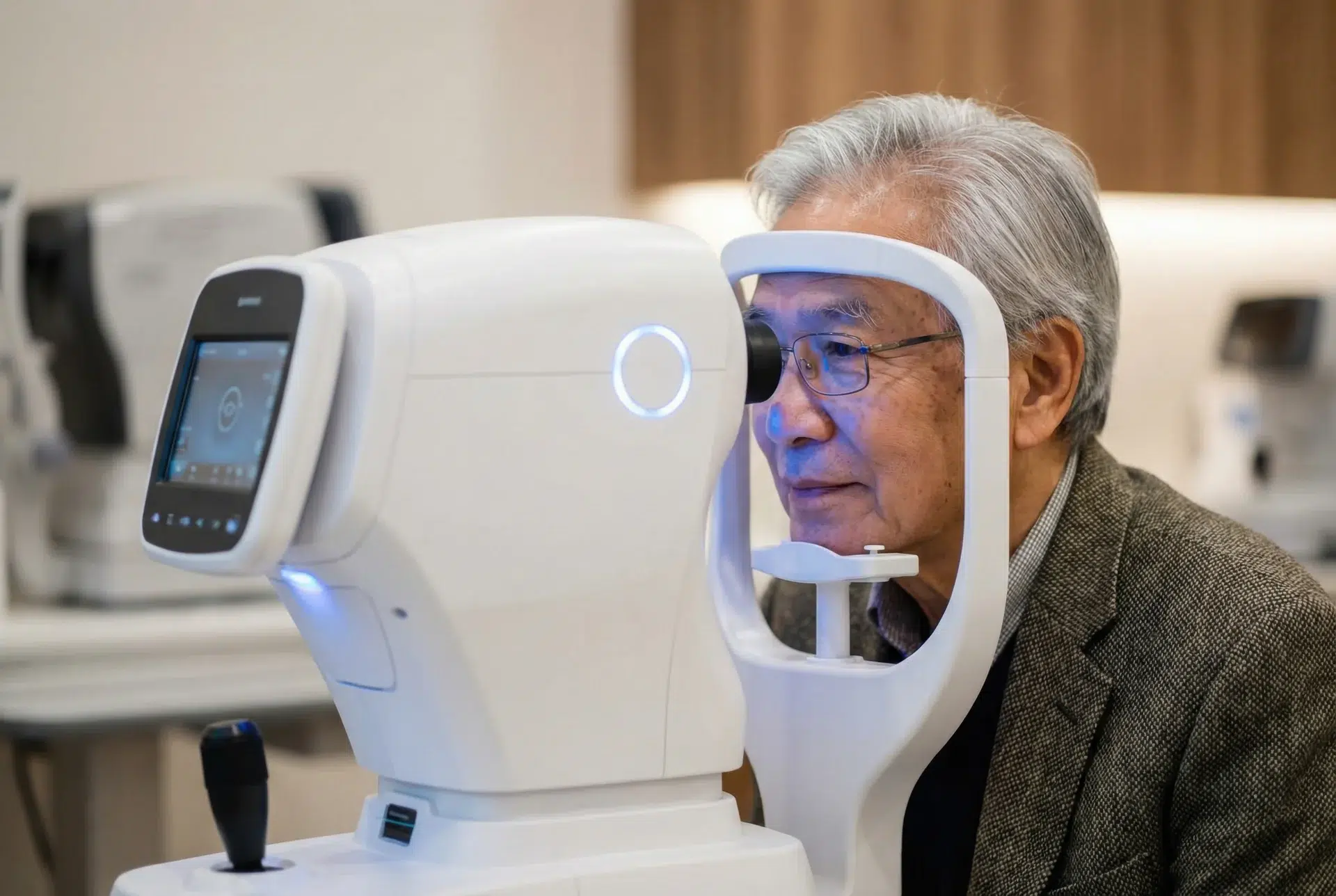
What it does not include is a dilated retinal examination, optical coherence tomography, or the detailed structural imaging that an eye specialist performs in a clinic. The screening is designed to identify candidates for follow-up, not to diagnose.
That distinction is important. A clean screening is reassuring but not a substitute for a comprehensive eye examination if there are risk factors like diabetes, high myopia, family history of glaucoma, or age over 60.
What Comes After a Screening Flag
If a community eye screening in Singapore flags a potential problem, the next step is a full assessment at an eye clinic. Depending on what was flagged, this may involve:
- A dilated examination of the retina and optic nerve
- Visual field testing for glaucoma
- Optical coherence tomography to image the layers of the retina
- A discussion of treatment or monitoring options based on the findings
For cataracts, the assessment confirms the stage of lens clouding and whether surgery is appropriate based on the patient’s daily visual needs. For glaucoma, it establishes a baseline of optic nerve health and visual field that can be tracked over time. For AMD, it determines the type (dry or wet) and whether anti-VEGF treatment is needed. For diabetic retinopathy, it identifies the level of retinal involvement and informs how often the patient should be reviewed.
Without this follow-up, the screening result sits as an unanswered question. With it, the result becomes the start of care.
How Private Eye Clinics Fit Into the Picture
Community screening is a public health activity, but its success depends on a working handoff to specialist care, which often happens in the private sector.
At Angel Eye & Cataract Centre, comprehensive eye examinations are available for seniors and adults who have received a community screening flag, who have a family history of eye disease, or who simply want a more detailed assessment than a basic screening provides. Dr Allan Fong has over 25 years of experience managing the conditions that community eye screening in Singapore is designed to catch, including cataracts, glaucoma, and age-related macular degeneration.
The point of the clinic visit is not to repeat the screening. It is to do what the screening cannot: examine the eye in detail, confirm or rule out the suspected condition, and put a plan in place.
Book a comprehensive eye examination at Angel Eye & Cataract Centre.
What Would a Stronger Screening System Look Like?
Expanding community eye screening in Singapore is not a single policy lever. It is several smaller ones, each addressing one of the gaps above.
- More frequent screening cycles in estates with higher senior populations, so that a missed event does not mean a missed year.
- Clearer referral pathways that link community screening events directly to clinics, ideally with help booking the follow-up appointment on the spot rather than handing over a leaflet.
- Targeted outreach through grassroots organisations, religious institutions, and family-member channels for seniors who are less likely to see standard health communications.
- Integration with diabetes management, given how strongly diabetic retinopathy tracks with poor glycaemic control in older adults.
- A simpler way to fund follow-up care for seniors who pass the screening stage but baulk at the cost of a comprehensive eye examination.
None of these is a radical proposal. Most exist in pilot form already. The question is whether they get resourced to the point where the one-in-three figure starts to fall.
