


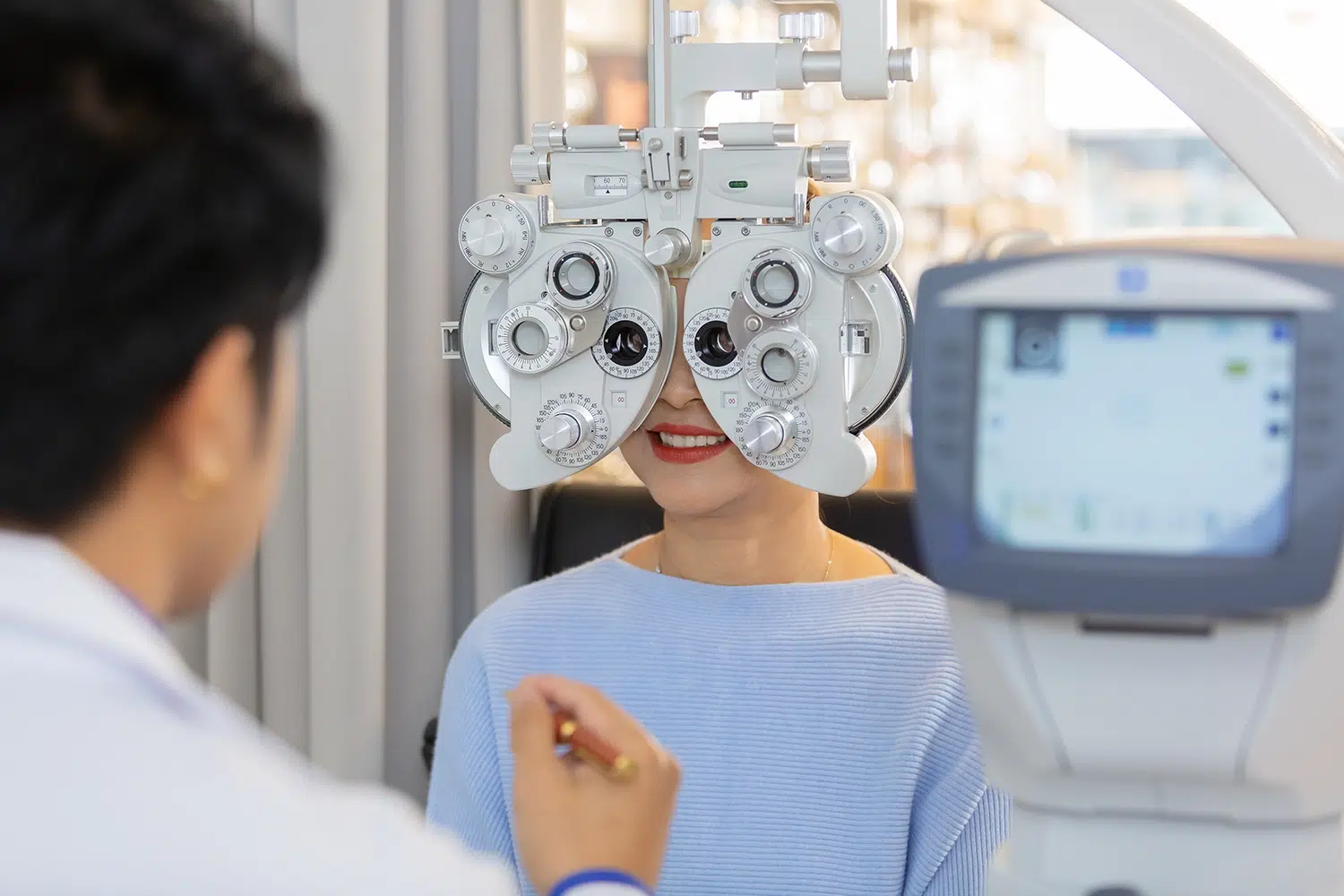
- Your GP is the right first call for eye complaints such as redness or discharge, but they cannot examine the structures inside your eye or detect conditions like cataracts or glaucoma.
- An optometrist measures your vision and can screen for abnormalities worth investigating further, but they cannot prescribe medication, make diagnoses, or perform procedures.
- In Singapore, an ophthalmologist is a medical doctor with the training and equipment to diagnose and treat the full range of eye diseases, though you should only see one if your symptoms go beyond what glasses can fix.
You notice it out of the corner of your eye: a fleeting flash of light, or a small dark speck drifting across your vision that was not there yesterday. It lasts a second. You blink, look again, and it seems to have settled. You tell yourself you are tired or have had too much screen time.
In that particular moment, deciding whether something is worth acting on, is where people tend to choose the wrong tier of eye care, or no care at all.
In Singapore, there are general practitioners, optometrists, and eye specialists. Knowing which to consult, and when, is what this guide covers.
What Are the Three Tiers of Eye Care in Singapore?

General Practitioners (GPs)
Your GP is often the fastest and most convenient first stop, and for certain conditions, that is entirely appropriate.
A GP can:
- Assess and treat straightforward conjunctivitis (inflammation of the surface of the eye, commonly known as pink eye)
- Prescribe basic antibiotic drops where needed
- Advise on minor irritation or discharge
- Refer you to an eye specialist if symptoms persist or vision is affected
A GP typically cannot:

Optometrists and opticians
An optometrist can:
- Measure refractive errors (short-sightedness, long-sightedness, and astigmatism) and prescribe corrective lenses
- Conduct fundus photography (a photograph of the retina) as part of a standard check
- Flag an unusual optic disc appearance, asymmetry in the cup-to-disc ratio (used in glaucoma assessment), or unexpected retinal changes (Tong et al., 2019; Hark et al., 2021)
- Refer you to an ophthalmologist when something warrants a closer look
An optometrist cannot:
- Prescribe medications or use diagnostic pharmaceuticals
- Diagnose eye disease
- Perform clinical procedures
Ophthalmologists (Eye Specialists)

In practice, an ophthalmologist’s clinic is equipped for a level of investigation the other two tiers are not. This typically includes:
- Slit lamp — a microscope used to examine the front of the eye in detail
- Optical coherence tomography (OCT) — a scan that images the individual layers of the retina
- Visual field testing (perimetry) — maps your field of vision to detect peripheral losses
- Gonioscopy — examines the drainage angle of the eye, used in glaucoma assessment
- Angiography — images the blood vessels of the eye where indicated
What Are the Signs That You Need an Ophthalmologist, Not Just an Optometrist?
What to Watch For
- Sudden vision changes of any kind, however mild they seem at first (Sharma et al., 2015; Margo & Harman, 2005)
- New floaters or flashes of light, particularly if they appear suddenly, can indicate a retinal tear or detachment (Sharma et al., 2015; Feltgen & Walter, 2014)
- Eye pain beyond mild, transient irritation
- Straight lines that appear bent, wavy, or distorted (Feltgen & Walter, 2014)
- A shadow, curtain, or dark patch across part of your visual field (Feltgen & Walter, 2014)
- Recent trauma to the eye, even if it looks unremarkable afterwards (Tan et al., 2026)
- Any vision change that persists after a glasses prescription update
When in Doubt, See a Specialist
If you are unsure whether your vision symptoms need attention, seeing an ophthalmologist in Singapore for a comprehensive eye examination is always the safer choice. Many patients spend months moving between a GP and an optometrist for symptoms that, in hindsight, warranted a specialist’s assessment from the start.
Dr Allan Fong is a Senior Consultant Eye Surgeon and Medical Director at Angel Eye & Cataract Centre, with over 26 years of experience in ophthalmology, and the former Head of the Cataract & Comprehensive Ophthalmology Department at Singapore National Eye Centre (SNEC).
Medical References
- Tong, W., Romero, M., Lim, V., et al. (2019). Reliability of graders and comparison with an automated algorithm for vertical cup-disc ratio grading in fundus photographs. Annals of the Academy of Medicine Singapore, 48(9), 282–289. PMID: 31737893.
- Hark, L.A., Kresch, Y.S., De Moraes, C.G., et al. (2021). Manhattan Vision Screening and Follow-up Study in Vulnerable Populations (NYC-SIGHT): design and methodology. Journal of Glaucoma, 30(5), 388–394. PMID: 33492894. DOI: 10.1097/IJG.0000000000001795
- Optometrists and Opticians Board. (2007). Optometrists and Opticians Act (Chapter 213). Singapore Ministry of Health. oob.gov.sg
- Foo, L.L., Lim, C.H., Loon, S.C., et al. (2019). Is there scope for expanding the optometrist’s scope of practice in Singapore? Clinical and Experimental Optometry, 102(3), 292–298. PMID: 30819628.
- World Health Organisation. (2026). Blindness and vision impairment. WHO Fact Sheet. who.int/news-room/fact-sheets/detail/blindness-and-visual-impairment
- Huang, Y., et al. (2026). Global burden and cross-country inequalities of age-related eye diseases from 1990 to 2021. Eye (Nature). PMC: 12861071. DOI: 10.1186/s40662-026-00473-5
- Sharma, P., Sridhar, J., & Mehta, S. (2015). Flashes and floaters. Primary Care: Clinics in Office Practice, 42(3), 425–435. PMID: 26319347. DOI: 10.1016/j.pop.2015.05.011
- Margo, C.E., & Harman, L.E. (2005). Posterior vitreous detachment: how to approach sudden-onset floaters and flashing lights. Postgraduate Medicine, 117(3), 37–42. PMID: 15782672. DOI: 10.3810/pgm.2005.03.1599
- Feltgen, N., & Walter, P. (2014). Rhegmatogenous retinal detachment — an ophthalmologic emergency. Deutsches Ärzteblatt International, 111(1–2), 12–21. PMID: 24565273. PMC: 3948016. DOI: 10.3238/arztebl.2014.0012
- Tan, C., Rayner, M., Eiselen, C., et al. (2026). Ophthalmic trauma: first-line management in primary care. Australian Journal of General Practice, 55(7), 449–454. PMID: 42392210. DOI: 10.31128/AJGP-12-25-7937
