


The encouraging news is that most cases are mild and settle, and the great majority never threaten sight. A minority, though, passes through a more active phase in which the inflammation worsens over months before stabilising, and a small number develop pressure on the optic nerve that needs prompt treatment. Knowing which signs are routine and which need urgent attention is one of the most useful things this article can give you. The single most important step within a person’s control is to stop smoking, which is strongly linked to more severe disease. Keeping thyroid levels well managed, easing dry eye and protecting the surface of the eye all help. A thorough eye examination, with input from an endocrinologist, can confirm the diagnosis, grade how active it is, and guide treatment. This article explains the signs, why the eyes bulge and see double, when the condition worsens, what helps day to day, and when symptoms need urgent attention. Read on for the full picture.
Hui Min (not her real name), 43, first noticed it in a photograph. At her niece’s birthday at the void deck of her sister’s HDB block, in a picture her sister had posted, her eyes looked wider than she remembered, almost startled, as though she had been caught mid-surprise. She laughed it off as a bad angle.
But the sense that something had changed did not fade. Her eyes felt dry and scratchy by late morning, worse in the office air-conditioning and on the cold MRT ride home, and they watered at odd moments even as they felt starved of moisture. Bright light made her squint, and some mornings her lids felt tight. A colleague gently asked whether she was getting enough sleep.
Then there were the small things she could not explain. The white of one eye looked pink and slightly swollen. Putting on mascara, she realised her upper lids were sitting higher than before, showing more white above her irises. Once or twice, reading the television subtitles, she caught a faint second image and had to blink it away.
She had felt on edge for months, her heart occasionally racing, her weight slipping down without trying. She had put it all down to a stressful year. It had not occurred to her that the racing heart and the changing eyes might be telling the same story.

What unsettled her most was the mirror. The face looking back was hers and yet not quite, the eyes a little too prominent, a little too bright. She began to avoid the camera, and then the mirror. One evening she finally typed her symptoms into her phone, and a phrase she had never heard kept coming back: thyroid eye disease.
Here is what was happening to her eyes.
What Is Thyroid Eye Disease, and Why Does It Happen?

What Are the Signs of Thyroid Eye Disease?
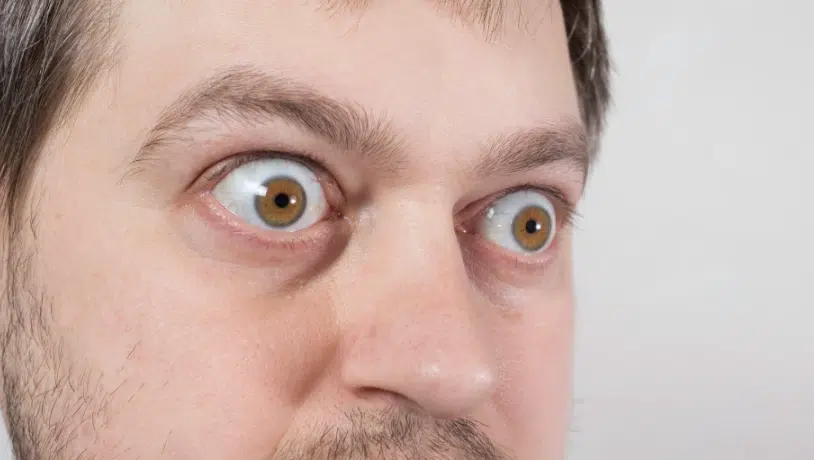
The most common signs are a staring or wide-eyed look as the lids pull back, eyes that appear to bulge forward, redness and swelling of the lids and the white of the eye, a dry, sandy feeling, and double vision as the eye muscles swell. Doctors call the bulging proptosis and the double vision diplopia.
Lid retraction and bulging are the two most common findings, and double vision can appear as the muscles that move the eye enlarge. These were the changes Hui Min had been seeing in the mirror. Thyroid eye disease symptoms can come on gradually, so they are easy to dismiss. Reassuringly, most thyroid eye disease is mild, and only a small minority becomes severe, but the signs are worth recognising early.
What to watch for
- A staring, wide-eyed look, or more white showing above the iris
- Eyes that look more prominent, or feel pushed forward
- Redness, swelling, a scratchy feeling, or new double vision
Why Do the Eyes Bulge Forward in Thyroid Eye Disease?

What to watch for
- One or both eyes looking pushed forward, or more white showing
- Lids that no longer close fully, especially overnight
- A clear difference in prominence between the two eyes
Why Does Thyroid Eye Disease Cause Double Vision?

What to watch for
- Two images that merge into one when you cover either eye
- Doubling that is worse on waking or when looking up or sideways
- New or constant double vision, particularly while driving
Can Thyroid Eye Disease Get Worse Over Time?

Daniel (not his real name), 54, noticed his changes far more quickly than Hui Min had. Over a single month his right eye grew visibly more prominent, his lids would not close fully at night, and a constant second image appeared whenever he drove home along the expressway. He began covering one eye to read his phone.
Then, one morning, the reds on his daughter’s school badge looked muddy and grey, as though someone had drained the colour from them. That was the sign that sent him to seek urgent help the same day, rather than waiting for his next routine review. His instinct was the right one. Washed-out colour, dimming vision, and new pain on moving the eyes are not symptoms to sleep on.
What to watch for
- Vision that seems to dim, or colours, especially red, that look washed out
- A rapid increase in bulging, or eyes that will not close at night
- New or worsening double vision, or pain when moving the eyes
Why Do the Eyes Feel So Dry in Thyroid Eye Disease?
Studies report that the great majority of people with thyroid eye disease experience dry eye symptoms, driven by greater exposure, incomplete blinking, blocked oil glands and reduced tear production. It was why Hui Min’s eyes felt dry and yet watery at the same time, often worse by the time she reached her hawker centre lunch. Easing the dryness is one of the most useful day-to-day measures, and you can read more on the clinic’s dry eye page.
What to watch for
- A scratchy, sandy or burning feeling, worse in air-conditioning
- Eyes that water and yet still feel dry
- Lids that do not seem to close fully, especially during sleep
What Helps Thyroid Eye Disease Day to Day?

Expert groups advise smoking cessation, keeping the thyroid in a normal range, and referral to a specialist for everyone with the condition, with lubrication for milder cases. Dr Fong’s guidance to patients adds that a Mediterranean-style diet rich in vegetables, fish, fruit and nuts may help reduce inflammation, although diet cannot cure thyroid eye disease. It also helps to limit excess iodine supplements, excessive sugar, highly processed foods and heavy alcohol, to stay well hydrated, and to ease back on salt if the lids are puffy. Because stress can aggravate Graves’ disease, relaxation and adequate sleep are worthwhile too.
What to watch for
- Stop smoking, the single most important change you can make
- Lubricating drops, good hydration, complete blinking and enough sleep
- A Mediterranean-style diet; less excess iodine, sugar, processed food and alcohol; less salt if the lids are swollen
Frequently Asked Questions About Thyroid Eye Disease in Singapore
Will the bulging and double vision from thyroid eye disease go away?
Often they improve as the active phase settles, and double vision may ease once the inflammation calms. Some bulging or eye-muscle change can remain afterwards and may be helped later by treatment. An assessment in Singapore can grade how active the disease is and guide what to expect.
Is thyroid eye disease dangerous, or will I lose my sight?
Most thyroid eye disease is mild and does not threaten sight; only a small minority becomes severe. Rarely, pressure on the optic nerve can affect vision and needs urgent care. At Angel Eye & Cataract Centre, the eyes are checked and graded for activity so that warning signs are caught early.
Can thyroid eye disease happen if my thyroid levels are normal?
Yes. Thyroid eye disease usually goes with Graves’ disease, but in a small number of people it appears when thyroid levels are normal or even low. If your eyes are changing, an assessment in Singapore can check both your eyes and your thyroid.
When Should You See an Eye Specialist About Thyroid Eye Disease?
See an eye specialist promptly, through your GP or polyclinic if needed, if you notice:
A new staring look, bulging, or eyes that will not close fully
Persistent redness, swelling, soreness or watering
New or worsening double vision, or pain when you move your eyes
A rapid change in how the eyes look over days or weeks
Any drop in vision, dimming, or colours looking washed out, which needs urgent attention
Where Can You Get Help for Thyroid Eye Disease in Singapore?
At Angel Eye & Cataract Centre, medical director Dr Allan Fong is an experienced eye specialist who assesses thyroid eye disease, grades how active and severe it is, and manages the dry eye and ocular surface problems that so often come with it. Dr Allan Fong works alongside endocrinologists so that the eyes and the thyroid are treated together, and explains the options for thyroid eye disease treatment clearly, from lubrication and eye protection through to the treatments used for more active or sight-threatening disease.
If your eyes have started to look or feel different, more prominent, drier, harder to close, or you are seeing double, it is worth finding out why, especially if your thyroid has been playing up. The change you see in the mirror has a name, and there is a great deal that can be done about it. Book an appointment at Angel Eye & Cataract Centre to have your eyes assessed for thyroid eye disease in Singapore.
References
- Wiersinga WM, Eckstein AK, Žarković M. Thyroid eye disease (Graves’ orbitopathy): clinical presentation, epidemiology, pathogenesis, and management. The Lancet Diabetes & Endocrinology. 2025;13:600–614. https://www.thelancet.com/journals/landia/article/PIIS2213-8587(25)00066-X/abstract
- Thyroid Eye Disease. StatPearls. Treasure Island (FL): StatPearls Publishing; updated 2025. Bookshelf ID NBK582134. https://www.ncbi.nlm.nih.gov/books/NBK582134/
- Graves Orbitopathy. StatPearls. Treasure Island (FL): StatPearls Publishing. Bookshelf ID NBK549889. https://www.ncbi.nlm.nih.gov/books/NBK549889/
- Thyroid-Associated Orbitopathy: Overview, Pathophysiology, Etiology. Medscape eMedicine. https://emedicine.medscape.com/article/1218444-overview
- National Organization for Rare Disorders (NORD). Thyroid Eye Disease (summary of EUGOGO recommendations). https://rarediseases.org/rare-diseases/thyroid-eye-disease/
- Park J, Baek S. Dry eye syndrome in thyroid eye disease patients: the role of increased incomplete blinking and Meibomian gland loss. Acta Ophthalmologica. 2019;97(5):e800–e806. DOI 10.1111/aos.14000. https://onlinelibrary.wiley.com/doi/full/10.1111/aos.14000
- Tear film break-up patterns in thyroid eye disease. Scientific Reports. 2021. https://www.nature.com/articles/s41598-021-84661-4
- Systematic review of ocular surface treatments in the setting of thyroid eye disease. Frontiers in Ophthalmology. 2024. https://www.frontiersin.org/journals/ophthalmology/articles/10.3389/fopht.2024.1352355/full
- Craig JP, et al. TFOS DEWS II Definition and Classification Report. The Ocular Surface. 2017;15(3):276–283. https://www.tfosdewsreport.org/report-definition_and_classification/48_36/en/
- Bartalena L, Kahaly GJ, Baldeschi L, et al. The 2021 European Group on Graves’ orbitopathy (EUGOGO) clinical practice guidelines for the medical management of Graves’ orbitopathy. European Journal of Endocrinology. 2021;185(4):G43–G67. DOI 10.1530/EJE-21-0479. https://academic.oup.com/ejendo/article/185/4/G43/6654384
- McKeag D, Lane C, Lazarus JH, et al. Clinical features of dysthyroid optic neuropathy: a European Group on Graves’ Orbitopathy (EUGOGO) survey. British Journal of Ophthalmology. 2007;91(4):455–458. PMC1994756. https://pmc.ncbi.nlm.nih.gov/articles/PMC1994756
