


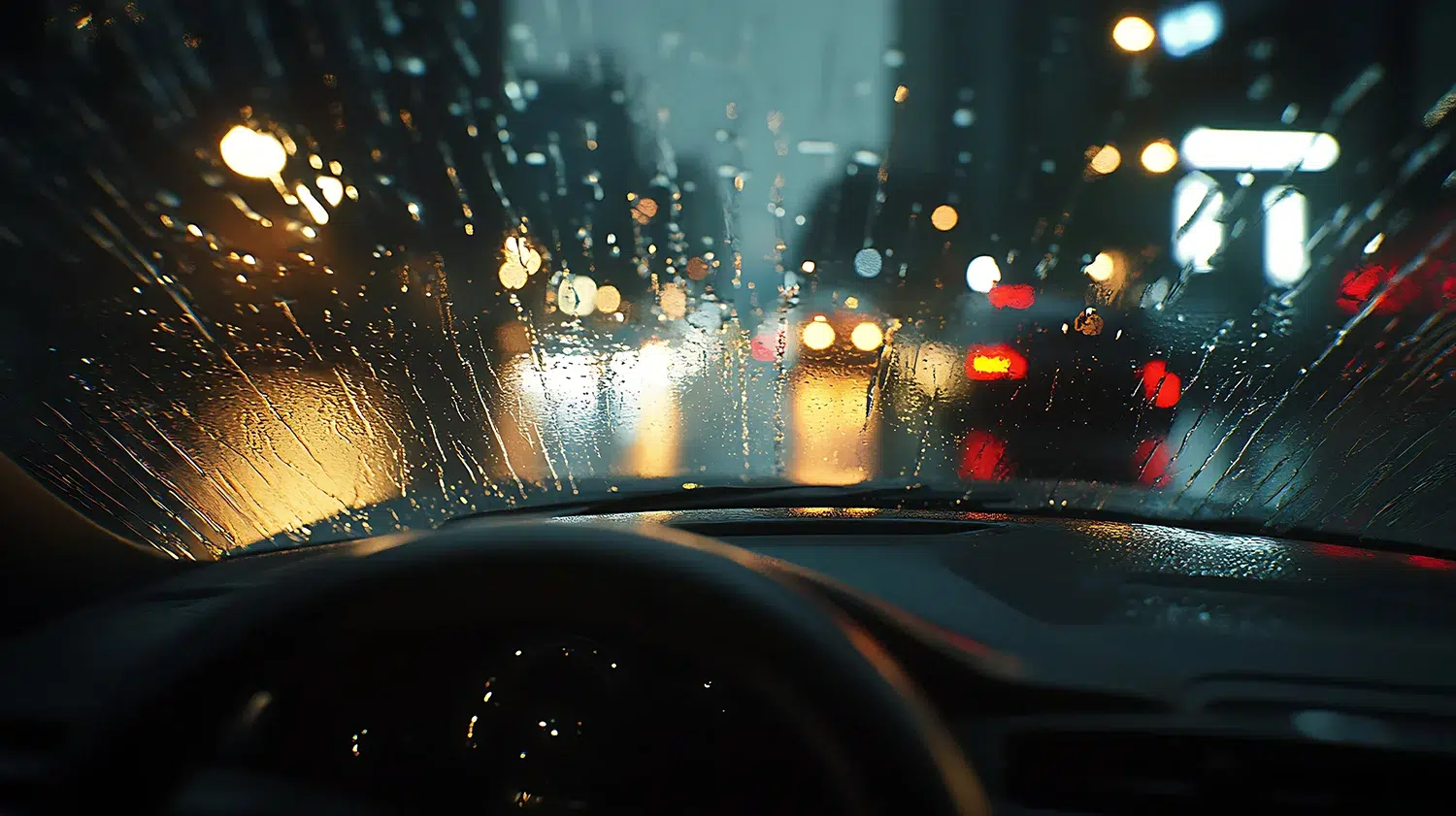
Cataracts scatter light into glare and halos that make night driving hazardous. Learn how cataracts affect night vision, and how eye cataract surgery can correct the glare and haloing.
Eye cataract surgery is one of the most common reasons Singaporeans report a dramatic improvement in night vision — because the clouded lens responsible for scattering light is removed and replaced with a clear artificial one. But most drivers do not connect what they are experiencing on the road at night to their eyes. They attribute the halos, the smeared headlights, and the difficulty reading wet lane markings to tiredness, to ageing, or to headlights that seem brighter than they used to be. By the time they seek assessment, the cataract has often been developing for years.
A cataract scatters incoming light rather than focusing it cleanly on the retina. In daylight, when the pupil is constricted, this effect is partially masked. At night, when the pupil dilates fully to let in more light, the scattering becomes dramatically worse. Headlights bloom into halos. Streetlamps trail starbursts across wet tarmac. Oncoming high-beams cause a flash of glare that takes several seconds to clear. Research confirms that cataract patients experience a significant and measurable increase in disability glare under low-light conditions, directly impairing the ability to detect pedestrians, judge distances, and react to road hazards.
If you have been avoiding night bookings, declining to drive after dark, or asking family members to take the wheel on evening trips, a cataract may be the reason. A comprehensive eye examination with a cataract specialist in Singapore is the first step. This article explains what cataracts do to night vision, why the symptoms are easy to explain away, and when the right time to act is. Read on for the full picture.
On a dry Tuesday night, James (not his real name) accepted a booking to Woodlands. PIE to BKE, forty minutes at that hour, nothing he had not done a hundred times. He pulled out of the carpark and joined the expressway.
The first pair of oncoming headlights hit him before the first interchange. They came in as a bloom — not two distinct points of light, but a wide, smeared glow that swallowed the lane markings and took a moment to clear. By the time it did, another vehicle was approaching. James squinted and moved his eyes slightly left of centre, the way he had learned to do over the past several months.
He had been a private hire driver for six years. He knew every interchange on the PIE, every camera placement on the CTE. He had driven through monsoon rain at midnight without anxiety. What he had not told his wife, or his operations manager, was that he had been declining night bookings for eight months. He cited tiredness. He cited a preference for daytime fares. What he did not say was that the road at night had become something he no longer fully trusted.
The starbursts around the Woodlands checkpoint floodlights were the size of his fist held at arm’s length. The green of the traffic light at the turning had a halo that bled into the amber of the adjacent signal. He parked, dropped off his passenger, and sat for a moment in the empty carpark.
He had been telling himself it was just tiredness for eight months. That evening, he decided to find out if it was something else.
Here is what was actually happening to his eyes.
Why Do Cataracts Cause Halos and Glare When Driving at Night?
Cataracts scatter incoming light across the retina rather than focusing it precisely. At night, when the pupil dilates to its widest, this scattering effect is significantly amplified — producing halos around point light sources, starbursts from headlights and streetlamps, and a loss of contrast that makes it harder to distinguish lane markings, pedestrians, and road hazards. Research confirms that disability glare increases substantially with cataract severity under low-light conditions. Eye cataract surgery removes the clouded lens and replaces it with a clear intraocular lens, eliminating the source of the scatter. (Aslam et al., Eye, 2007, DOI: 10.1038/sj.eye.6702603)
The natural lens of the eye bends incoming light to a sharp focus on the retina. When proteins within the lens break down and clump — the process that defines a cataract — those clumps scatter light in multiple directions. During the day, the pupil is constricted, partially masking the effect. After dark, when the pupil is fully open, the full scatter is exposed.
“Think of it like looking through frosted glass,” says Dr Allan Fong of Angel Eye & Cataract Centre. “In bright light it is an inconvenience. Switch to a dark room with a single bright lamp, and the frosted glass becomes genuinely disabling. That is exactly what the cataractous lens does to a driver at night.”

Is It Safe to Drive with Cataracts in Singapore?
Driving with cataracts in Singapore carries genuine safety risks, particularly at night. Research published in Investigative Ophthalmology and Visual Science found that cataract patients required significantly more illumination to detect pedestrians in low-light conditions compared to age-matched controls. Singapore’s Traffic Police recommend that drivers seek medical assessment if vision changes affect driving ability. A cataract specialist can determine whether your vision meets safe driving standards. (Wood et al., Investigative Ophthalmology and Visual Science, 1994)
The legal standard for driving vision in Singapore requires a minimum corrected visual acuity of 6/12 in the better eye. But this measure does not capture glare sensitivity, contrast sensitivity, or recovery time after a flash of bright light — all of which are impaired by cataracts long before visual acuity drops below the threshold. A driver can pass the vision requirement on paper while experiencing functional night vision impairment that represents a genuine hazard.
James had not considered whether his driving was safe — only whether it was comfortable. By the time night driving feels obviously dangerous, the visual impairment is typically well advanced. For cataract treatment in Singapore to be most effective, earlier assessment is always preferable to waiting for vision to deteriorate further.

What to Watch For
- Oncoming headlights that seem significantly brighter than they used to be
- Halos or rings around streetlamps, traffic lights, or lit signage at night
- Starbursts trailing from point light sources on wet road surfaces
- Difficulty recovering quickly from the glare of high-beam headlights
- A growing tendency to avoid expressway driving or night driving altogether
- Needing to slow down significantly to feel confident at night
Why Does Wet Weather Make Cataract Glare Worse on Singapore Roads?
Wet road surfaces reflect and multiply light sources, increasing the total glare load on the eye. For a driver with cataracts, whose lens already scatters light abnormally, wet-weather driving compounds the disability glare effect substantially. Singapore’s frequent rainfall means drivers with cataracts face these conditions regularly throughout the year. Research confirms that contrast sensitivity loss — the functional measure most relevant to wet-road driving — correlates strongly with cataract severity. (Vingopoulos et al., Clinical Ophthalmology, 2022, PMC: 9509679)
A dry road presents a limited number of light sources. A wet road multiplies each of them — every streetlamp acquires a rippling reflection, every set of headlights produces a shimmer on the tarmac, and lane markings become harder to distinguish against the general brightness of the wet surface. For a driver with cataracts, the combination of lens scatter and road reflection can make lane discipline genuinely difficult.
James had noticed this specifically. Dry nights on the PIE were manageable. Rain changed everything. The expressway lights bounced off the wet surface and filled his visual field with a diffuse glow that made the lane lines almost invisible. He had begun following the vehicle in front more closely than he should — using their tail-lights as a guide when the markings were unclear.
What to Watch For
- Lane markings that become hard to see when the road surface is wet
- Expressway driving in rain that feels significantly more stressful than it used to
- Using the vehicle ahead as a visual reference more than the road markings
- Avoiding wet-weather driving or taking longer, less-lit routes after rain
- Streetlamp reflections on wet surfaces that seem overwhelming rather than manageable
Does Eye Cataract Surgery Improve Night Driving?
Yes. Eye cataract surgery removes the clouded natural lens and replaces it with a clear intraocular lens, eliminating the source of light scatter responsible for halos, starbursts, and glare. Research confirms significant improvements in night driving performance and disability glare following surgery, with patients reporting measurably safer and more confident driving in low-light conditions. Most patients in Singapore are cleared to resume driving within a few days of the procedure. (Rubin et al., Archives of Ophthalmology, 1993; National Eye Institute, 2023)
The improvement is structural, not gradual. Patients consistently describe night driving after the procedure as the clearest evidence of what they had been missing: headlights that are distinct rather than smeared, streetlamps that are crisp rather than haloed, lane markings that are visible rather than washed out. For drivers whose livelihood depends on night hours — private hire drivers, delivery workers, night-shift commuters — the restoration is occupational as much as visual. (For more on how cataracts affect working drivers, see: He Worked for 30 Years Behind the Wheel. Cataracts Nearly Took All of It.)
The procedure is performed under local anaesthetic in Singapore. The clouded lens is removed through a small incision and a clear intraocular lens inserted in its place. Most patients report improved vision within twenty-four hours, with driving clearance typically following within a few days, subject to the operating surgeon’s assessment.
What to Watch For
- Any sustained difficulty with night driving lasting more than a few weeks
- Halos or starbursts that are present every night rather than occasionally
- A pattern of declining night bookings, avoiding evening trips, or asking others to drive after dark
- Vision that is noticeably worse at night than in daytime conditions
- Glare recovery that takes longer than a few seconds after a bright light source passes
Frequently Asked Questions About Eye Cataract Surgery in Singapore
Why do cataracts cause halos and glare when driving at night?
Cataracts scatter incoming light rather than focusing it cleanly. At night, with the pupil fully dilated, this scattering is amplified — producing halos around streetlamps, starbursts from headlights, and contrast loss that impairs hazard detection. Eye cataract surgery removes the clouded lens, eliminating the scatter and restoring clear night vision.
Does eye cataract surgery improve night driving in Singapore?
Yes. Eye cataract surgery replaces the clouded lens with a clear intraocular lens, removing the structural cause of night glare and halos. Research confirms significant improvements in disability glare and night vision after the procedure. Most patients in Singapore are cleared to resume driving within a few days, subject to their cataract specialist’s assessment.
Is it safe to keep driving if I have cataracts in Singapore?
It depends on severity. Standard driving vision tests measure letter-chart acuity but not glare or contrast sensitivity — the measures most relevant to night driving safety. If you notice halos, glare, or difficulty driving after dark, a comprehensive assessment by a cataract specialist in Singapore is the appropriate next step before continuing to drive regularly at night.
When Should You Seek an Eye Assessment for Night Driving Difficulties?
Do not wait for a near-miss on the road. Night vision problems from cataracts are progressive — they do not improve on their own. Seek a comprehensive eye examination if any of the following apply:
- Halos, starbursts, or glare around headlights and streetlamps at night
- Night driving that feels significantly more stressful than it did two or three years ago
- Glare recovery from oncoming high-beams that takes more than a few seconds
- Lane markings or road signs that are harder to read at night than in daylight
- A pattern of avoiding night driving, declining night bookings, or deferring to other drivers after dark
- Daytime vision that seems adequate but night vision that feels unreliable or unsafe
About Angel Eye & Cataract Centre
Angel Eye & Cataract Centre is a specialist eye clinic in Singapore focused on cataract diagnosis and surgical treatment. Dr Allan Fong has over 25 years of experience in cataract surgery and regularly assesses patients whose primary complaint is deteriorating night vision — drivers, night-shift workers, and commuters who have been managing around a problem they have not yet named. The clinic provides comprehensive pre-operative assessments including glare sensitivity and contrast sensitivity testing, a range of intraocular lens options, and post-surgical care with realistic recovery planning for patients who need to return to driving promptly.
Patients concerned about how their night vision may be affecting their driving safety are welcome to arrange a consultation to discuss their specific requirements and assessment options with Dr Allan Fong directly.
The road at night should not feel like a hazard. If driving after dark has become something you manage around rather than something you do with confidence, it is time to find out why. Contact Angel Eye & Cataract Centre to arrange a comprehensive eye examination. A cataract specialist in Singapore can assess what a standard vision test cannot — and eye cataract surgery, when indicated, is a routine day procedure.
Medical References
- Aslam, T.M., Haider, D., & Murray, I.J. (2007). Principles of disability glare measurement: an ophthalmological perspective. Eye, 21, 1019–1027. DOI: 10.1038/sj.eye.6702603
- Wood, J.M., Dique, T., & Troutbeck, R. (1994). The effect of restriction of the binocular visual field on driving performance. Investigative Ophthalmology and Visual Science, 36(5), 814–824.
- Vingopoulos, F., Kasetty, M., Garg, I., et al. (2022). Active Learning to Characterize the Full Contrast Sensitivity Function in Cataracts. Clinical Ophthalmology, 16, 3109–3118. PMC: 9509679. DOI: 10.2147/OPTH.S367490
- Rubin, G.S., Adamsons, I.A., & Stark, W.J. (1993). Comparison of acuity, contrast sensitivity, and disability glare before and after cataract surgery. Archives of Ophthalmology, 111(1), 56–61. DOI: 10.1001/archopht.1993.01090010060027
- Owsley, C., Stalvey, B.T., Wells, J., et al. (2001). Visual risk factors for crash involvement in older drivers with cataract. Archives of Ophthalmology, 119(6), 881–887. DOI: 10.1001/archopht.119.6.881
- Khoo, J.Z.Y., et al. (2022). Six-Year Incidence of and Risk Factors for Cataract Surgery in a Multi-ethnic Asian Population: The Singapore SEED Study. British Journal of Ophthalmology, 106(11), 1503–1507. DOI: 10.1136/bjophthalmol-2020-318609
- Blachnio, K., Dusinska, A., Szymonik, J., et al. (2024). Quality of life after cataract surgery. Journal of Clinical Medicine, 13(17), 5209. DOI: 10.3390/jcm13175209
- Kaur, K., & Gurnani, B. (2023). Contrast Sensitivity. StatPearls. National Library of Medicine. NBK580542.
- National Eye Institute. (2023). Cataracts. nei.nih.gov
- Ministry of Health Singapore. (2023). Cataract. moh.gov.sg
- Singapore Traffic Police. (2024). Medical fitness to drive. spf.gov.sg
